AttendingScorer:an end-to-end driving evaluator that reads out trajectory quality from a frozen VLM从冻结 VLM 的隐表示中读出轨迹质量的端到端驾驶评估器
The judgment is already inside the frozen driving VLM — the failure lives in the readout. TrajSteering trains only a shared query bank and an affine scalar head: a pseudo-score loss fixes what to predict, a teacher-conditioned deflection criterion fixes how to read. No weight updates. No rule gates.判断力早已存在于冻结的驾驶 VLM 内部——失灵的只是读出通道。TrajSteering 只训练一组共享 query 与一个仿射标量头:pseudo-score 损失决定读什么,teacher-conditioned deflection 准则决定怎么读。不改一个权重,不设一条规则门。
Motional & NVIDIA Research TeamMotional 与 NVIDIA Research 团队
Scene & trajectory tokens enter the frozen VLM (❄). An appended [score] query attends over frozen context states — TrajSteering reshapes only which positions it taps — and an affine head reads out the quality score.场景与轨迹 token 进入冻结 VLM(❄)。附加的 [score] query 在冻结的上下文状态上做注意力——TrajSteering 只重塑它敲击哪些位置——仿射头随即读出质量分。
The problem问题
Every existing fix rewrites the evaluator现有方案都在重写评估器本身
Driving VLMs can explain why a trajectory is unreasonable, yet their prompted numerical scores stay unstable. The field's response has been to install scoring ability — by prompting harder, routing through rules, or retraining weights. Each path gives something up:驾驶 VLM 能解释一条轨迹为何不合理,但直接提示得到的数值分始终不稳定。领域的应对是把打分能力"装进去"——更用力地 prompt、路由回规则、或重训权重。每条路都要付出代价:
① Direct Prompting
Unstable scores分数不稳定
Ratings collapse to a few round values (≈24 effective levels); repeated queries disagree with themselves.评分坍缩到少数整数值(约 24 个有效等级);重复询问自相矛盾。
② DriveJudge
Rule-capped被规则封顶
Semantic judgment routed through fixed rule gates — the model can excuse a penalty but never impose an unseen one.语义判断被路由回固定规则门——模型能豁免惩罚,却永远加不出规则外的新惩罚。
③ DriveCritic
Weights must move必须动权重
LoRA / SFT / RL installs the score but re-opens the backbone — forfeiting the deployed model's reproducibility.LoRA / SFT / RL 把分数装了进去,但重新打开了 backbone——部署模型的可复现性随之作废。
— AttendingScorer
Read out, not installed读出,而非装入
Backbone stays frozen; a lightweight shared-query readout recovers the score from representations that already exist.backbone 全程冻结;轻量共享 query 读出通道从既有表示中恢复分数。
Core question. How much of the trajectory-quality information decodable from a frozen driving VLM's representation can be recovered through the readouts its own causal attention interface realizes?核心问题:冻结驾驶 VLM 表示中可解码的轨迹质量信息,有多少能通过它自身因果注意力接口所能实现的读出通道恢复出来?
Method · TrajSteering方法 · TrajSteering
Two objectives, zero backbone changes两个目标函数,backbone 零改动
The score query's context-attention branch is exactly a weighted aggregation of frozen values — its attention weights act as filter taps, but only within the readout family the frozen model can realize. TrajSteering selects the right member of that family:score query 的上下文注意力分支恰好是冻结 value 的加权聚合——其注意力权重就是滤波器抽头,但只能落在冻结模型可实现的读出族内。TrajSteering 要做的是在这个族里选对成员:
1
Freeze & append冻结并附加
A shared query bank E and one score query trail the multimodal context (Qwen2.5-VL-7B, every parameter frozen). Causal masking leaves the original context untouched.共享 query 组 E 与一个 score query 追加在多模态上下文之后(Qwen2.5-VL-7B,参数全冻结)。因果掩码保证原上下文分毫不动。
the interface接口
2
Pseudo-score lossPseudo-score 损失
A rule-gated teacher auto-generates targets — no human labels, no preference pairs. This fixes what to predict, bypassing the collapsed numeric-token channel.规则门控 teacher 自动生成监督目标——无人工标注、无偏好对。它决定读什么,绕开坍缩的数字 token 通道。
Inside the attention-filtered latent: estimate the score-aligned direction, whiten residual nuisance variation, reward readouts whose signal survives. This fixes how to read.在注意力滤波后的隐变量里:估计分数对齐方向,白化残余扰动,奖励信号存活的读法。它决定怎么读。
how to read怎么读
ρTCD(E) = ŝE⊤ D̂E−1 ŝE
signal-over-nuisance deflection, computed on the exact context-attention branch; discarded at inference — deployment is a single frozen forward pass.信号/扰动 deflection,在精确的上下文注意力分支上计算;推理时弃用——部署就是一次冻结前向。
TrajSteeringThe constrained-filtering view, live — contribution waveforms per latent channel, attention taps as volume knobs, the frozen attention filter plane, and the filtered output.约束滤波视角实时演示——每个 latent 通道的贡献波形、作为音量旋钮的 attention taps、冻结注意力滤波面与过滤输出。
This is TrajSteering (chapter 04 of the interactive story): a shared query handle moves every tap together inside the frozen model's realizable readout family — from a shortcut reading to an evidence reading.这就是 TrajSteering(交互式讲解第 04 章):共享 query 手柄在冻结模型可实现的读出族内联动所有 taps——从 shortcut 读法走向证据读法。
Results · WOD-E2E, zero human labels in training结果 · WOD-E2E,训练零人工标注
Human-aligned scoring from a frozen interface冻结接口上的人类对齐打分
Pairwise accuracy成对准确率
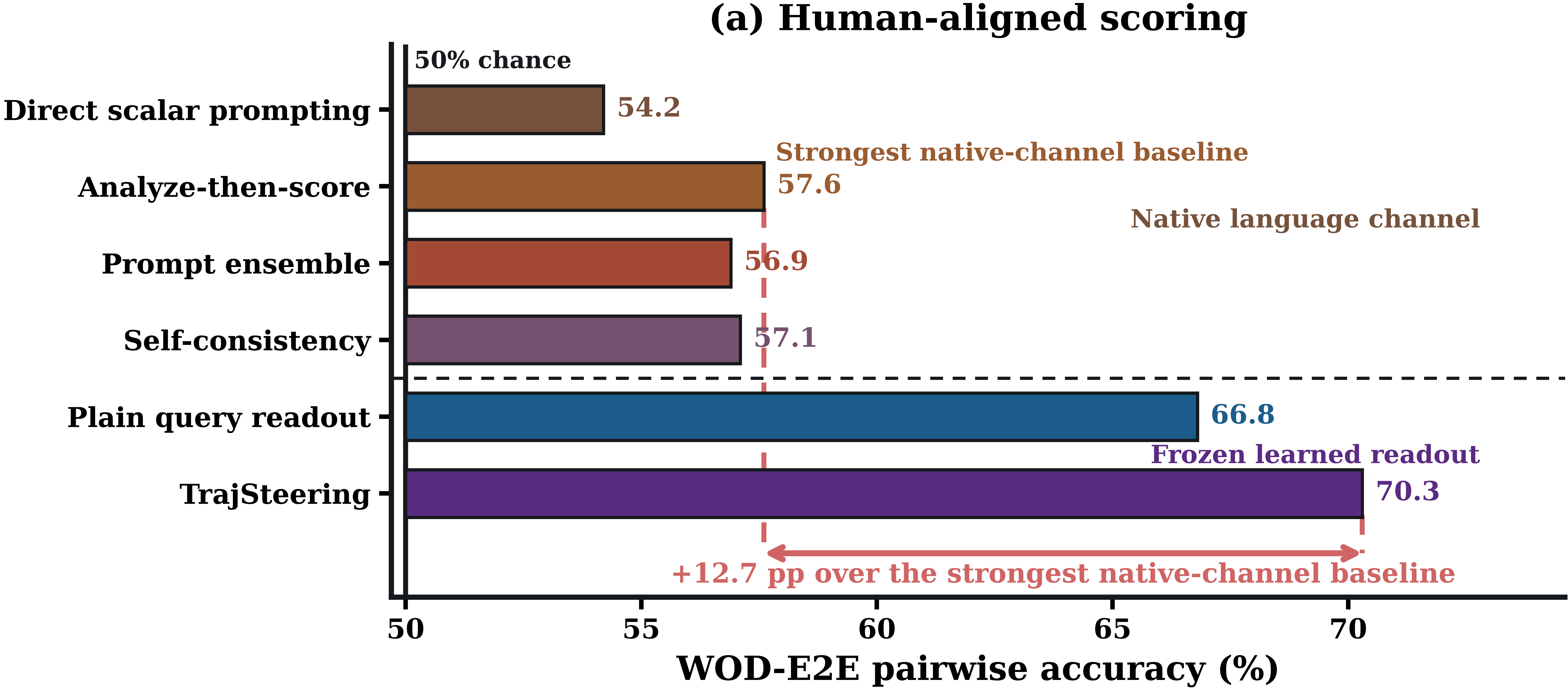
54.2% → 70.3%
+16.1 pts vs direct promptingpts 对比直接提示
1.2 pts below LoRA — with zero weight updates仅比 LoRA 低 1.2 pts——且零权重更新
NDCG@3
0.81 → 0.91
+0.10 vs direct prompting对比直接提示
MAE 2.31 → 2.10 vs plain readoutMAE 2.31 → 2.10(对比朴素读出)
Teacher blind-spot MAETeacher 盲区 MAE
3.95 → 2.79
TranscendRate 60.7%超越率 60.7%
beats its own teacher where rules pass but humans object在"规则放行而人类反对"处超越其 teacher
Failure-separation AUC失效分离 AUC
0.635 → 0.867
score-CDF separationscore-CDF 分离度
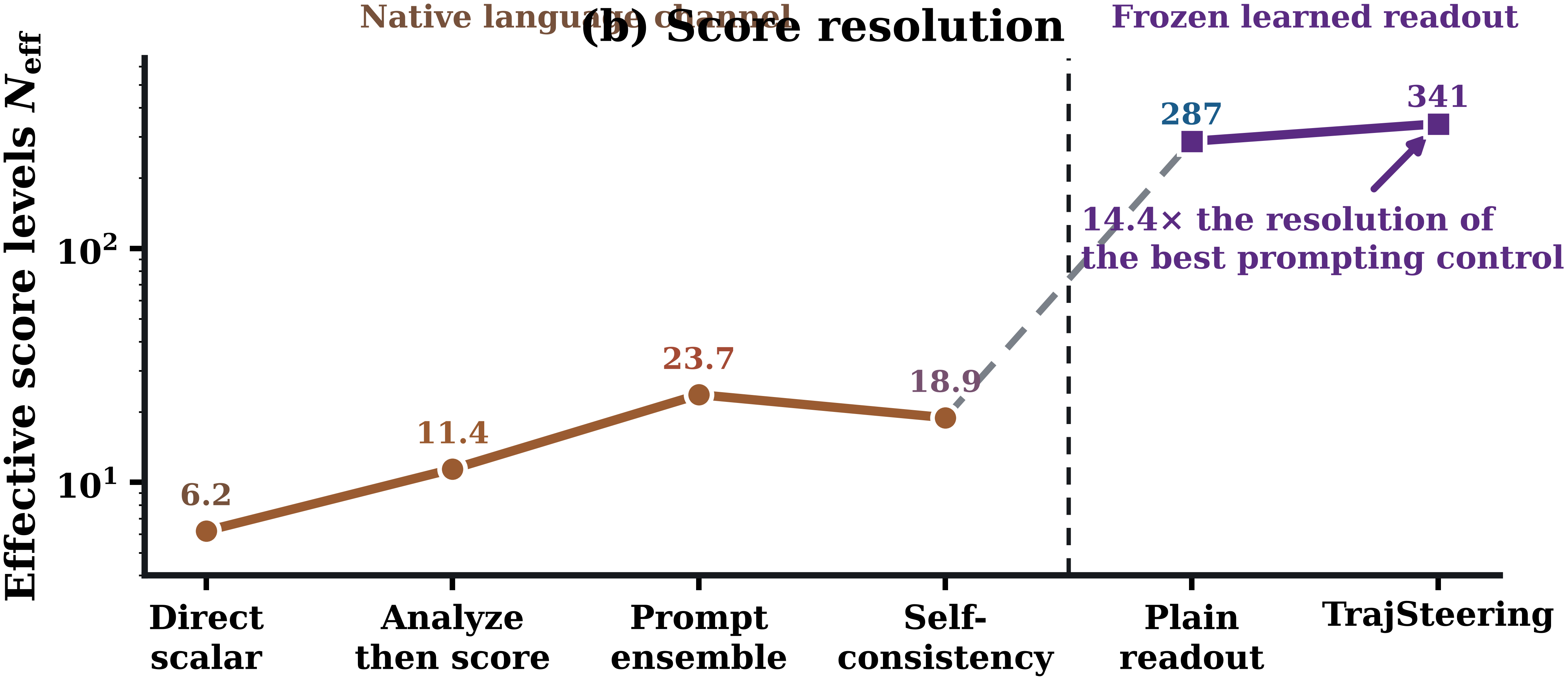
341 effective score levels vs 23.7 by prompting341 个有效分级,提示法仅 23.7
Causal, not correlational: suppressing the top-attended positions of the learned readout costs −8.5 pts pairwise accuracy; random equal-mass suppression costs −1.4. The attention pattern is the mechanism. Full protocol in the paper, §5.因果而非相关:抑制已学读出通道注意力最高的位置,成对准确率掉 −8.5 pts;等质量随机抑制只掉 −1.4。注意力模式就是机制本身。完整协议见论文 §5。
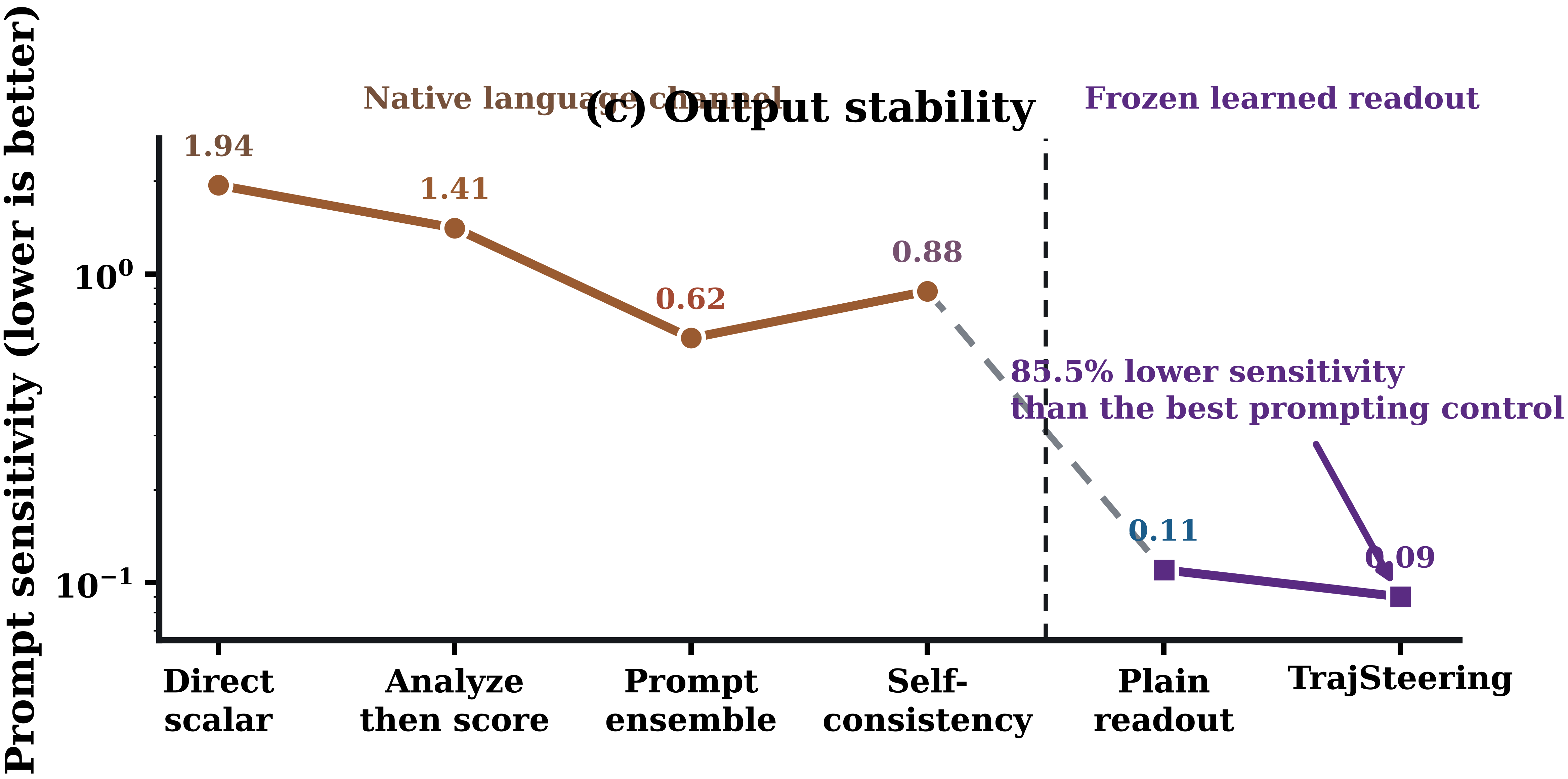
Figure 4 of the paper: native textual scoring versus frozen learned readouts. Stronger elicitation (analyze-then-score, prompt ensembles, self-consistency) improves the native channel but never closes the gap — the learned query interface extracts a better scalar from the same frozen backbone on all three axes.论文图 4:原生文本打分 vs 冻结已学读出。更强的诱导(analyze-then-score、prompt 集成、self-consistency)能改善原生通道,但始终无法弥合差距——同一冻结 backbone 上,学习到的 query 接口在三条轴上都提取出更好的标量。
Worked examples · from the case-study volume完整示例 · 取自案例研究卷宗
One long-tail scene, one ordinary scene一个长尾场景,一个普通场景
Three planners each, with every scorer's number and the VLM's own words — migrated intact from the case studies. "Ideal" is derived, not asserted: it is the rule score with incorrectly-imposed penalties removed.每个场景三个规划器,所有评分器的分数与 VLM 原话——从案例研究完整搬迁。“Ideal” 是推导而非断言:即去除误加惩罚后的规则分。
Long-tail (OOD)长尾(OOD) · long-tail · 6d8d91ad290f
Rule penalties here: VLA1 progress 0.683, VLA2 progress 0.599 — with collision, drivable-area, traffic-light and time-to-collision all 1.000. A vehicle is stopped 14 m ahead in this lane: the slowdown is correct, so the progress penalty is wrong.此处规则惩罚:VLA1 progress 0.683、VLA2 progress 0.599——而 collision、drivable-area、traffic-light、time-to-collision 全为 1.000。本车道前方 14 m 有车停驶:减速是正确的,progress 惩罚是误加的。
Ideal 0.857 — every criterion is clean, so a correct scorer should return the rule's own score所有判据都干净,正确的评分器应返回规则自身的分数
model's own words模型原话
The candidate trajectory is reasonable: it maintains a safe distance from the stopped vehicle ahead, stays within the marked lane, and avoids conflicts with surrounding traffic. The trajectory appears to be a smooth, legal stop at the intersection, which is contextually necessary given the traffic light and oncoming traffic.
Score: 95
Ideal 0.884 — progress is penalised to 0.683 while collision, drivable-area, traffic-light and time-to-collision are all 1.000, and a vehicle is stopped 14 m ahead in this lane — the slowdown is correct, so removing that penalty gives 0.884progress 被罚至 0.683,而 collision、drivable-area、traffic-light、time-to-collision 全为 1.000;本车道前方 14 m 有车停驶——减速正确,去除该惩罚即得 0.884
model's own words模型原话
The candidate trajectory is reasonable: it maintains forward progress in the current lane, avoids collisions with nearby vehicles and obstacles, and stays within the drivable area. The slight curve to the right appears contextually necessary to navigate around a stopped vehicle ahead while remaining legal and safe.
Score: 90
Ideal 0.893 — progress is penalised to 0.599 while collision, drivable-area, traffic-light and time-to-collision are all 1.000, and a vehicle is stopped 14 m ahead in this lane — the slowdown is correct, so removing that penalty gives 0.893progress 被罚至 0.599,其余判据全为 1.000;前方 14 m 停驶车辆使减速正确,去除该惩罚即得 0.893
model's own words模型原话
The candidate trajectory is reasonable: it maintains forward progress in the current lane, avoids collisions with nearby vehicles and obstacles, and stays within the drivable area. The slight curve to the right appears contextually necessary to navigate around a stopped vehicle ahead while remaining legal and safe.
Score: 90
Ordinary普通场景 · ordinary · ebe3f434bfee
Every criterion is clean for all three planners; the rule scores them all 1.000. The interesting question becomes ranking within a tie — where score resolution matters.三个规划器的所有判据都干净,规则分一律 1.000。有趣的问题变成并列内部的排序——这正是分数分辨率发挥作用的地方。
Ideal 1.000 — every criterion is clean, so a correct scorer should return the rule's own score所有判据都干净,正确的评分器应返回规则自身的分数
model's own words模型原话
The candidate trajectory is reasonable: it maintains a safe distance from the white car crossing in front and stays centered in the lane, avoiding any risky maneuvers. The trajectory appears to be a smooth, legal turn into the intersection, consistent with the surrounding traffic and road markings, and shows no unnecessary lane deviation.
Score: 90
Ideal 1.000 — every criterion is clean, so a correct scorer should return the rule's own score所有判据都干净,正确的评分器应返回规则自身的分数
model's own words模型原话
The candidate trajectory is reasonable: it maintains a safe distance from the intersecting traffic, stays within the drivable lane, and avoids conflict with other vehicles and agents. The trajectory appears to smoothly navigate the intersection without abrupt maneuvers, suggesting good progress and comfort while adhering to traffic rules.
Score: 90
Ideal 1.000 — every criterion is clean, so a correct scorer should return the rule's own score所有判据都干净,正确的评分器应返回规则自身的分数
model's own words模型原话
The candidate trajectory is reasonable: it maintains forward progress in the current lane, avoids collisions with nearby vehicles, and stays within the drivable area. The slight curve to the right appears contextually necessary to navigate the intersection safely while yielding to cross-traffic, and the trajectory is smooth and comfortable for the ego vehicle.
Score: 90
All six cases with planner-separation statistics live in the full case-study volume.全部六个案例与规划器分离度统计见完整案例研究卷宗。
@misc{attendingscorer2027,
  title     = {AttendingScorer: An End-to-End Driving Evaluator that Reads Out
               Trajectory Evaluation Score from Latent of Vision-Language-Model},
  author    = {{Motional} and {NVIDIA Research Team}},
  howpublished = {\url{https://crcr0.github.io/AttendingScorer/}},
  year      = {2027}
}