Seven routing laws on the same controlled multi-agent system, then the statistics behind conservation and verification.
1. The seven routing laws
How the rows differ. All seven laws see the same histories, the same frozen executor and the same precommitted key. They differ only in which constraints the key must respect: none (unprojected bias), first-step rewards only (immediate-value), or the full continuation values (RouterMAS). The random feasible row keeps the constraints but ignores the key; the two inert rows show where the carrier vanishes. Columns are maxima over all twenty histories except mean KL.
utilitycost
Worst prefix value drift by law (log scale). Values below 10−14 are floating-point rounding.
RouterMASimmediate-value law
Local continuation residual |(q−p)⊤QU| + |(q−p)⊤QC| at each of the 20 histories. At the last step (t = 3) nothing follows, so Q = r and the two laws coincide.
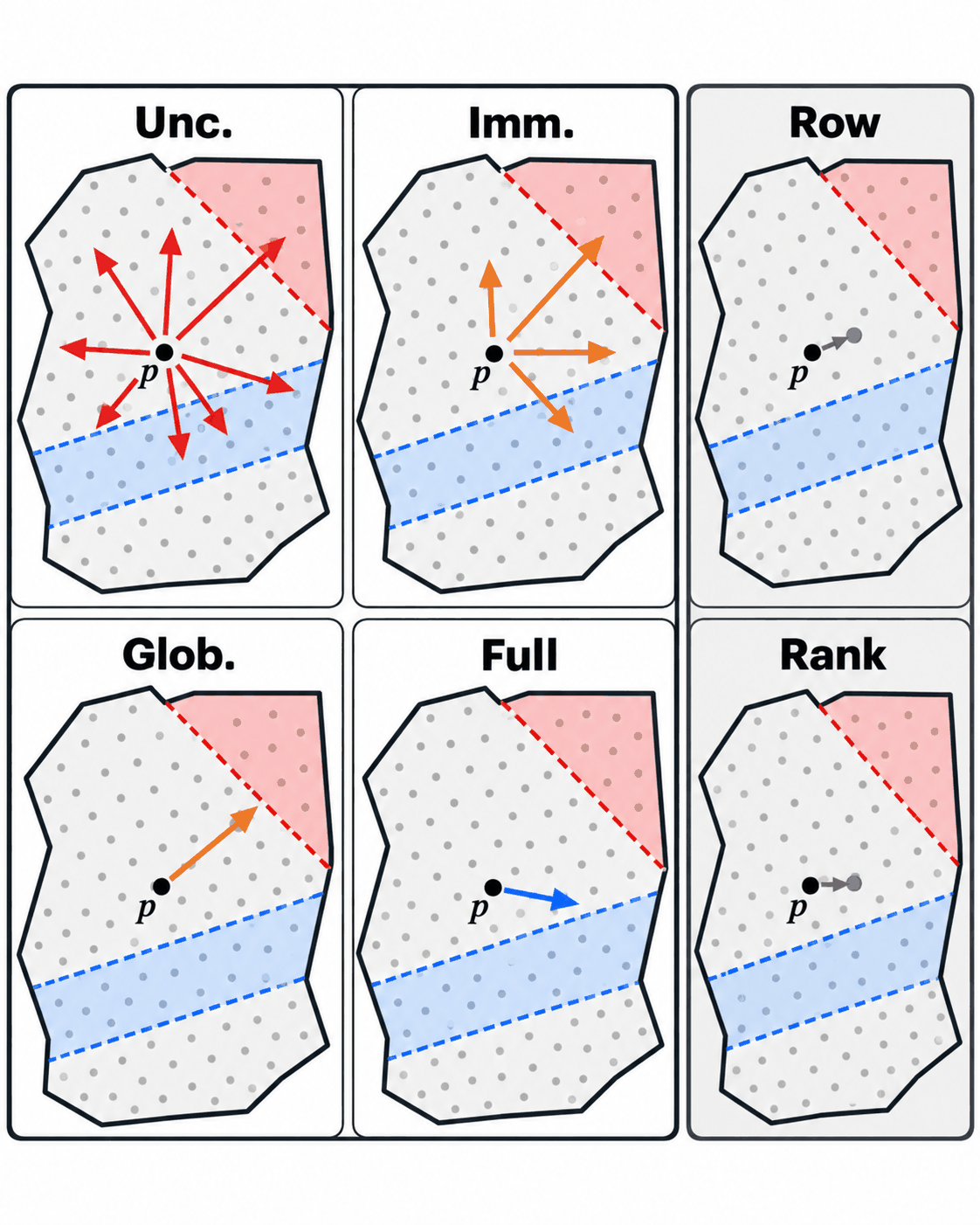
Schematic of the intervention geometry: unconstrained (Unc.), immediate-value (Imm.), global-average (Glob.) and full continuation-value (Full) interventions; row-space keys (Row) and full-rank constraints (Rank) are inert. Quantities are in the table above.
2. Case studies
What a case shows. Each case is one history of the finite-state system: six legal delegations with their reference probability p, the RouterMAS law qK, the immediate-value law, both continuation values QU and QC, both first-step rewards rU and rC, and the key score sK. The summary rows are computed from the table: the local conservation residual (q − p)⊤Q is what Proposition 1 requires to vanish, and the residual on r is what the immediate-value law makes vanish instead.
Three histories are shown: the one where the key moves the most probability, the one where it moves the least, and the one where matching only first-step rewards leaves the largest continuation drift.
Inert controls
Control
Setting
Why the carrier vanishes
Returned law
KL
Full-rank three-action control
p = (0.2, 0.3, 0.5); rows (0.1, 0.6, 0.8) and (0.8, 0.2, 1.1)
rank B = 3 = number of delegations; only p is feasible
p exactly
0
Row-space key
sK = B⊤(0.3, 0.7, −0.2) at all 20 histories
sK⊤(q − p) = 0 for every feasible q, so the objective reduces to −η KL
p (to 10−16)
0
Four-action constructive witness
An exact example with hand-checkable arithmetic: the direction d = (1, −3, 3, −1) satisfies 1⊤d = 0, QU⊤d = 0 and QC⊤d = 0, so every law p + t·d with small t keeps utility 0.70 and cost 1.50 while the key score changes.
3. Do the laws separate across all histories?
Per-history statistics for the three laws that move probability under the key. RouterMAS keeps the local conservation residual at rounding level everywhere; the immediate-value law conserves first-step rewards but not continuation values; unprojected bias conserves neither.
Show all twenty histories
4. Statistical evidence
4.1 Sequential detection
marked (qK)reference (p)log(1/α), α = 0.01
Twenty sampled trace groups per law from the same sampler, decisions 1–256.
TPR α = 0.01TPR α = 0.001FPR α = 0.01
Rates over 10,000 independent trace groups per law; running-maximum rejection.
Rejection uses the running maximum of the log evidence across repeated four-step episodes, so a trace group counts as detected if it ever reaches log(1/α) within the budget. The reference false-positive rate stays below α at every budget, as Ville's inequality guarantees for the conditional-action null.
4.2 Embedding–evidence relation (Corollary 1)
4.3 Estimated-value audit (independent prototype)
An independent Python implementation of Algorithms 1–2 with its own finite-state generator (same dimensions and seed; generator distributions specified by the implementation), continuation values estimated from complete reference rollouts with a Hoeffding/union-bound error envelope.
5. What these experiments establish
Established with exact dynamics. Prefix-wise conservation holds to rounding precision while routing changes; a law that matches only first-step rewards leaves downstream drift; row-space keys and full-rank histories are inert; the keyed gain and the expected log evidence follow the shared projection of Corollary 1; the running-maximum likelihood-ratio test keeps its false-positive rate below α while its power grows with the audit budget.
Measured on LLM multi-agent systems. Task success, operating cost, prefix drift DU,95 and fixed-FPR detection on reasoning (GSM8K), code generation (HumanEval, MBPP) and environment interaction (ALFWorld), with centralized, layered and graph-routed routers, are the subject of the evaluation protocol in the extended abstract. Numbers in this volume come only from the controlled systems described above.